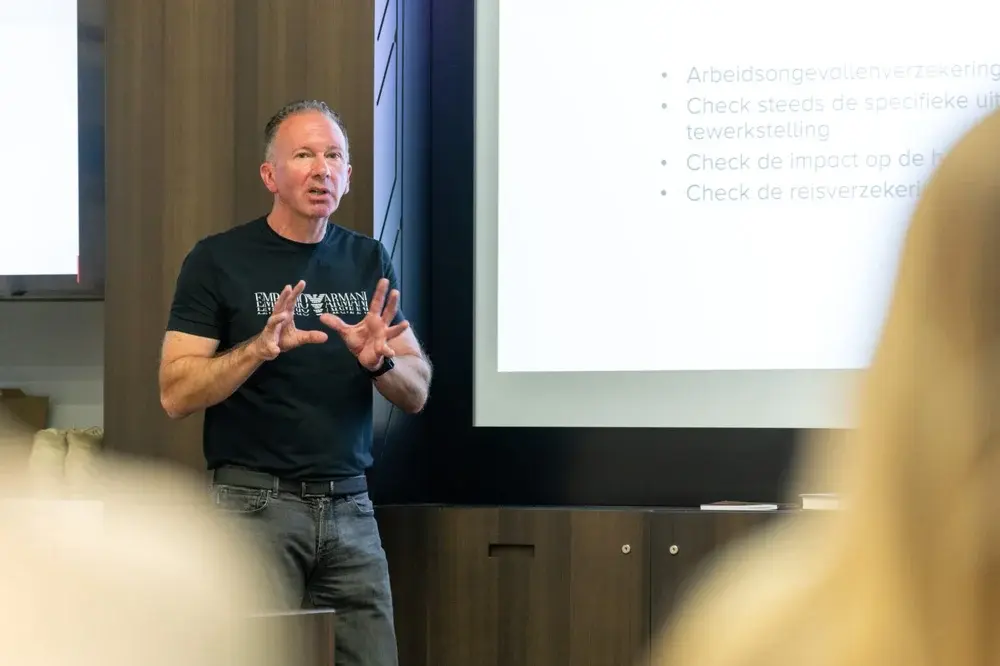
"Nathalie Arteel invited 20 HR directors to the table for a debate on appreciation and engagement."
In this feature, we map out the latest trends in Rewards & Recognition and explore the key levers that can turn rewards into meaningful experiences.
A Challenging Context
The Federal Planning Bureau forecasts that wages in 2024 will rise again—not just a little: according to their calculations, by the end of 2024, wages will have increased by 26% over four years. If we consider the total wage bill, including new jobs, the increase even reaches 33% over four years. For employees, this is obviously good news, as it helps maintain purchasing power in Belgium better than elsewhere. For employers, however, this creates a particularly challenging context: the Planning Bureau expects the wage index to be exceeded in February and June next year, with a high probability of a third exceedance. In that scenario, wages could increase by more than 8% within just one and a half years.
Naturally, this leaves less budget for additional salary increases. Companies must therefore explore alternative forms of reward. In 2023, winning the war for talent increasingly relies on non-financial benefits. We need to think more about how employees experience rewards (reward experience). KPIs and clear targets remain essential, but they are best decoupled from direct compensation. It is also wise to provide sufficient flexibility and autonomy so employees can agree with their managers on objectives and how they will be recognized and rewarded for achieving them.
Three Trends in Rewarding
Xavier Baeten, Professor of Reward & Sustainability at Vlerick Business School, emphasizes the crucial role of reward policies in achieving business strategy success and competitive advantage. He advocates for a greater focus on non-financial rewards and identifies three trends in rewarding:
- Sustainability: in both the form of rewards and the choice of incentives.
- Personalization: allow employees to choose for themselves and involve managers in the process.
- Participatory reward management: ensure the system is supported by all stakeholders.
Do I earn enough – do I learn enough – am I happy at work?
A good salary package alone is not enough to sustainably engage employees. Engagement is much more about the frequency of rewards and, crucially, the timing of recognition and appreciation. Rewards will only motivate if they address the three basic needs employees have at work, drawing from Self-Determination Theory by Edward Deci and Richard M. Ryan. Another relevant framework mentioned is Skinner’s positive reinforcement theory: desired behavior must be rewarded shortly after it occurs.
Expressing appreciation and fostering a culture of gratitude are essential to create a climate of trust. Without trust, no reward policy can truly motivate. From the employee’s perspective, three questions must be answered:
- Do I earn enough? (Is my salary fair and competitive?)
- Do I learn enough? (Are my competence and development needs met?)
- Am I happy? (To what extent do I experience work happiness, well-being, and vitality?)
Five Tips for a Motivating Reward Policy
- Set clear objectives.
- Make the process participatory.
- Avoid a purely mathematical link between goals and rewards.
- Surprise with rewards.
- Act quickly and decisively!
Best Practice: Blue Diamond Recognition Program – Van Moer
At Van Moer, there are no CAO 90 agreements or standard bonuses. Instead, they focus resolutely on creativity. Their reward policy aligns with the company’s values: no-nonsense, flexibility, partnership, enthusiasm, and making a difference. The growth and success of Van Moer are entirely thanks to the commitment and engagement of all employees.
Through their Blue Diamond recognition program, every positive contribution is rewarded. Rewards are based on six clearly defined and well-communicated objectives. One such objective is reducing workplace accidents. Managers are given autonomy and rewards, while employees can collect “JO tokens” and choose when to exchange them for one or more gifts. Over the course of a year, the number of workplace accidents decreased by 27.5%.
Moving Away from the 3 D’s
We are undeniably operating in a context of wage cost control and salary optimization, but that is only half the story. Overregulation and policies designed to cover every possible problem will never achieve the desired effect. It is better to start from a foundation of trust and move away from the 3 D’s:
- That can’t be done
- That isn’t allowed
- That is impossible
Recognition is not about giving bonuses—it’s about how we make people feel. In other words, shift from finance-driven to experience-driven. Joris De Wortelaer has structured his law firm around the ideal job, and he allows his employees to do the same. At Bloom Law, employees work at 80% capacity, leaving room for interesting cases. Never push your employees into overdrive.